




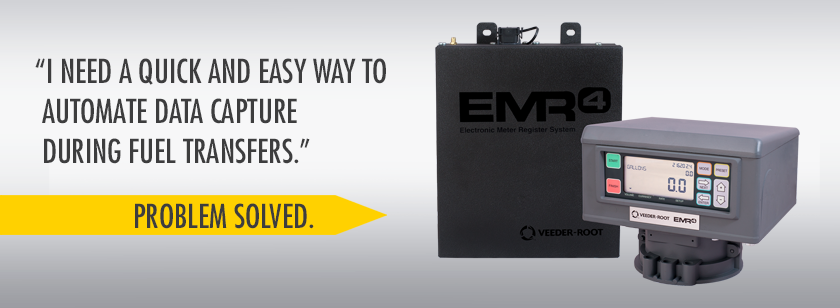
EMR4 - Electronic Meter Register

Proud to be Powered by Vontier. Sharing a united vision that is driven by innovation. Find out more

EMR4

The EMR4 Electronic Meter Register system is an automated method for capturing data during fuel transfers. With multiple communication ports, programmable relays, pulse outputs, temperature compensation, OBC commands for remote control, and much more built standard into every register, EMR4 provides the versatility required for integration into any type of application.

Key features:

  • Dual Register Head System - Simultaneous Operation with one IB box
  • Global Weights & Measures approval for installation anywhere in the world
  • UL, ATEX, IECEx certified
  • Class 1 Division 1 certification for approved installation in all mobile and stationary applications
  • Two RS-232 communication ports for easy access to data and/or remote control
  • Built with integrated Wi-Fi for future wireless accessibility
  • Built-in USB for easy, 3-step software upgrades. Software upgrades continuously available on veeder.com at no charge, assuring your system can grow with your needs
  • Anti-fog, Nitrogen-purged, Ultra-Bright LED White Backlit Display
  • Programmable relays for Electronic Valve Control, Pump Control, and much more
  • Three pulse outputs per Display Head each with selectable voltage for XL LED displays, Additive Injection Systems, Tank Level Systems, and more
  • Removable connectors for easy field wiring
  • Multiple power and ground terminals for easy accessory field wiring
  • Enhanced memory and processing power for fast, robust operation


AUTOMATION OF DATA TO ELIMINATE LOSS

EMR4 ensures that capturing and transmitting transaction data is seamless and simple. Automated data capture, whether direct from the EMR4 or via wireless with Datalink, guarantees the integrity of all delivery data and reduces loss due to antiquated and manual processes. What does this mean for you? No more lost, missing, or miswritten paper tickets.
 

VERSATILITY TO MAKE INTEGRATION SIMPLE

EMR4 was designed to simplify operations for its users. With multiple communication ports, programmalble relays, pulse outputs, temperature compensation, OBC commands for remote control, and much more built standard into every register, EMR4 provides the versatility required for integration into any type of application.
 

SECURITY TO KEEP ASSETS & OPERATIONS SAFE

EMR4 offers the necessary security to keep your fueling assets safe. With a proprietary operating system and optional settings to prevent unauth­ orized access, the EMR4 eliminates tampering and theft and keeps track of every drop of fuel. Until authorized by built-in password protection or through a peripheral security device, EMR4 will not allow a delivery without proper authorization, protecting your bottom line.
 

  • 3 I/O Com Ports (RS 232/485)
  • UL, ATEX and IECEx Approved
  • Weights and Measures World-Wide Approval: OIML, CW&M, French, NCWM (NIST Standards)
  • Display Head rated for -40° to 60° C
  • Store hundreds of transactions in built-in, Non-volatile memory
  • Currency and Volume Preset Deliveries
  • Multiple Product Deliveries on a single ticket
  • Built-in support for Multiple Languages
  • Customizable system text labels and delivery tickets
  • Single or Multi-Point Calibration
  • Multi-tier Price/fax/Discount (Percentage, Flat Rate and Surcharge)
  • Remote Emergency Start-Stop interface for each Head
  • Daisy Chain up to 32 Register Heads in one network
  • Multiple Communication Ports (RS 232/485)


Request a Quote


<script>

// CONFIG: map UTM parameter names -> input selectors
const fieldMap = {
utm_source: 'input[name="1097612_221968pi_1097612_221968"]',
utm_medium: 'input[name="1097612_221965pi_1097612_221965"]',
utm_campaign: 'input[name="1097612_221959pi_1097612_221959"]',
utm_content: 'input[name="1097612_221962pi_1097612_221962"]'
};

// CONFIG: whether to save values read from the URL into sessionStorage
const saveUrlToSession = true;

function safeSessionGet(key) {
try {
return sessionStorage.getItem(key);
} catch (e) {
return null;
}
}

function safeSessionSet(key, value) {
if (!saveUrlToSession) return;
try {
sessionStorage.setItem(key, value);
} catch (e) {
// ignore storage write failures
}
}

function getUrlParam(paramName) {
const urlParams = new URLSearchParams(window.location.search);
return urlParams.get(paramName); // returns null if not present
}

function setFieldValue(el, value) {
if (!el) return;
el.value = value;
// trigger input/change events for libraries that listen for them
el.dispatchEvent(new Event('input', { bubbles: true }));
el.dispatchEvent(new Event('change', { bubbles: true }));
}

function populateKey(paramName, selector) {
const el = document.querySelector(selector);

// 1) Try sessionStorage first
const sessVal = safeSessionGet(paramName);
if (sessVal !== null && sessVal !== '') {
setFieldValue(el, sessVal);
return;
}

// 2) Fallback to URL param
const urlVal = getUrlParam(paramName);
if (urlVal !== null && urlVal !== '') {
setFieldValue(el, urlVal);
safeSessionSet(paramName, urlVal); // store for future pages if enabled
}
}

function populateHiddenFields() {
Object.keys(fieldMap).forEach(paramName => {
populateKey(paramName, fieldMap[paramName]);
});
}

if (document.readyState === 'loading') {
document.addEventListener('DOMContentLoaded', populateHiddenFields);
} else {
populateHiddenFields();
}

// Optional: allow manual calls from other scripts
window.populateHiddenFields = populateHiddenFields;

(function () {
// CONFIG
const fieldMap = {
utm_source: 'input[name="1097612_221968pi_1097612_221968"]',
utm_medium: 'input[name="1097612_221965pi_1097612_221965"]',
utm_campaign: 'input[name="1097612_221959pi_1097612_221959"]',
utm_content: 'input[name="1097612_221962pi_1097612_221962"]'
};
const saveUrlToSession = true;

// Safe session helpers
function safeSessionGet(key) {
try { return sessionStorage.getItem(key); } catch (e) { return null; }
}
function safeSessionSet(key, value) {
if (!saveUrlToSession) return;
try { sessionStorage.setItem(key, value); } catch (e) {}
}

// URL helper
function getUrlParam(paramName) {
const urlParams = new URLSearchParams(window.location.search);
return urlParams.get(paramName);
}

// DOM helper
function setFieldValue(el, value) {
if (!el) return;
el.value = value;
el.dispatchEvent(new Event('input', { bubbles: true }));
el.dispatchEvent(new Event('change', { bubbles: true }));
}

// Core: check session first, then URL
function populateKey(paramName, selector) {
const el = document.querySelector(selector);
const sessVal = safeSessionGet(paramName);
if (sessVal !== null && sessVal !== '') {
setFieldValue(el, sessVal);
return;
}
const urlVal = getUrlParam(paramName);
if (urlVal !== null && urlVal !== '') {
setFieldValue(el, urlVal);
safeSessionSet(paramName, urlVal);
}
}

// Populate all configured fields
function populateHiddenFields() {
Object.keys(fieldMap).forEach(paramName => {
populateKey(paramName, fieldMap[paramName]);
});
}

// Init
if (document.readyState === 'loading') {
document.addEventListener('DOMContentLoaded', populateHiddenFields);
} else {
populateHiddenFields();
}
window.populateHiddenFields = populateHiddenFields;
})();
</script>

<script>
document.addEventListener('DOMContentLoaded', function() {
// Function to get URL parameters
function getUrlParam(paramName) {
const urlParams = new URLSearchParams(window.location.search);
return urlParams.get(paramName);
}

// Get the utm_source value
const utmSource = getUrlParam('utm_source');
const utmMedium = getUrlParam('utm_medium'); // Also get others
const utmCampaign = getUrlParam('utm_campaign');
const utmContent = getUrlParam('utm_content');

// --- Method 1: Direct Assignment (if form fields exist) ---
// Find your form fields by name/ID and set their value
const sourceField = document.querySelector('input[name="1097612_221968pi_1097612_221968"]'); // Adjust selector
if (sourceField && utmSource) {
sourceField.value = utmSource;
}
const mediumField = document.querySelector('input[name="1097612_221965pi_1097612_221965"]'); // Adjust selector
if (mediumField && utmMedium) {
mediumField.value = utmMedium;
}
const campaignField = document.querySelector('input[name="1097612_221959pi_1097612_221959"]'); // Adjust selector
if (campaignField && utmCampaign) {
campaignField.value = utmCampaign;
}
const contentField = document.querySelector('input[name="1097612_221962pi_1097612_221962"]'); // Adjust selector
if (contentField && utmContent) {
contentField.value = utmContent;
}
// Repeat for medium, campaign, etc.

// --- Method 2: Store in Session Storage (Recommended for multi-page) ---
// This keeps data across page views before form submission
if (utmSource) {
sessionStorage.setItem('utm_source', utmSource);
}
if (utmMedium) {
sessionStorage.setItem('utm_medium', utmMedium);
}
if (utmCampaign) {
sessionStorage.setItem('utm_campaign', utmCampaign);
}
if (utmContent) {
sessionStorage.setItem('utm_content', utmContent);
}
});

// Function to populate form on any page load (using session storage)
function populateHiddenFields() {
const utm_source = sessionStorage.getItem('utm_source');
const utm_medium = sessionStorage.getItem('utm_medium');
const utm_campaign = sessionStorage.getItem('utm_campaign');
const utm_content = sessionStorage.getItem('utm_content');

const sourceInput = document.querySelector('input[name="1097612_221968pi_1097612_221968"]');
if (sourceInput && utm_source) {
sourceInput.value = utm_source;
}
const mediumInput = document.querySelector('input[name="1097612_221965pi_1097612_221965"]');
if (mediumInput && utm_medium) {
mediumInput.value = utm_medium;
}
const campaignInput = document.querySelector('input[name="1097612_221959pi_1097612_221959"]');
if (campaignInput && utm_campaign) {
campaignInput.value = utm_campaign;
}
const contentInput = document.querySelector('input[name="1097612_221962pi_1097612_221962"]');
if (contentInput && utm_content) {
contentInput.value = utm_content;
}
}

// Run this when the form loads on the *final* page (e.g., the form page itself)
// Call populateHiddenFields(); when your form element is ready or on DOMContentLoaded again.
</script>